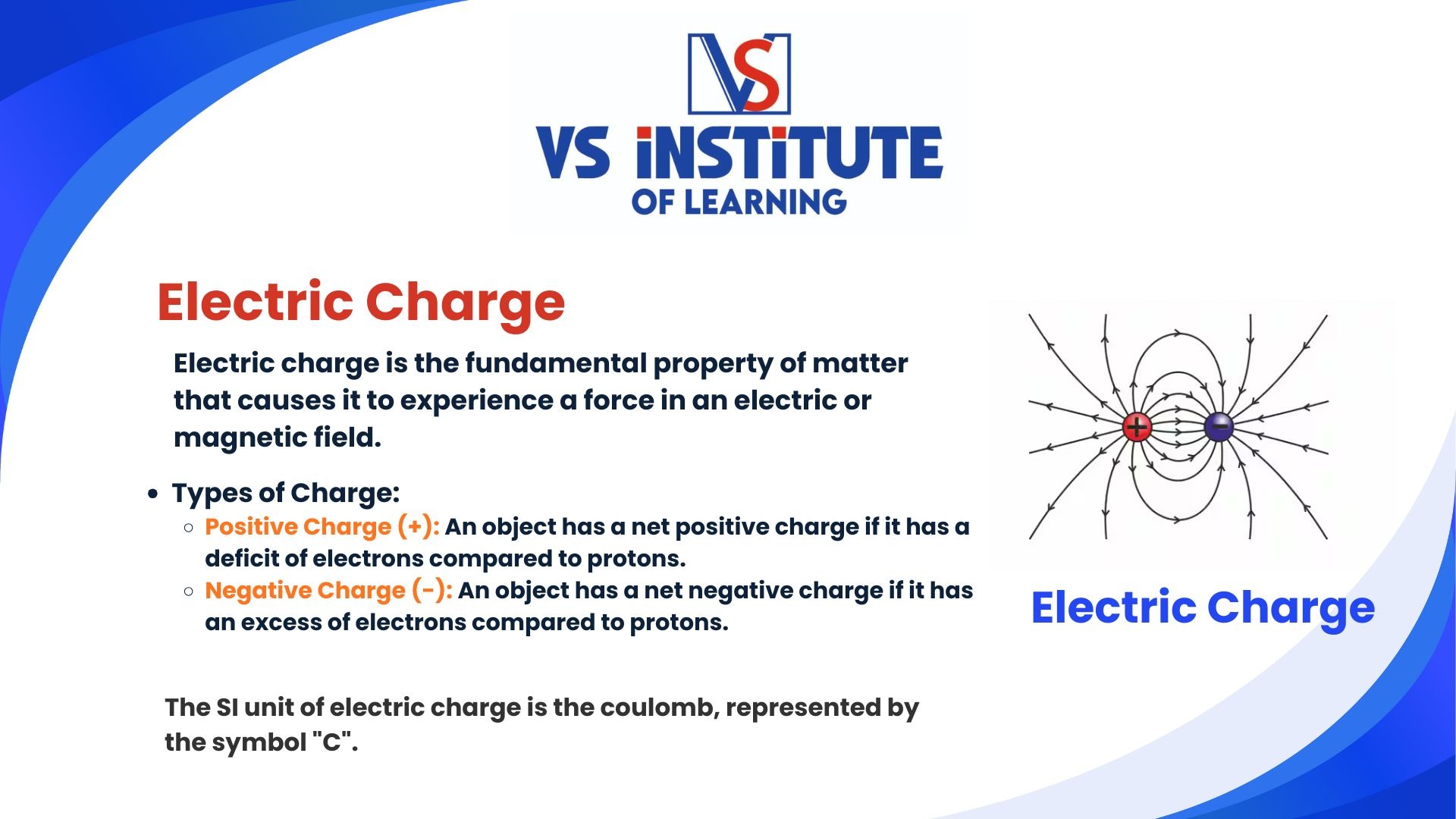
Electric charge can be defined as a fundamental property of subatomic particles that gives rise to the phenomenon of experiencing force in the presence of electric and magnetic fields. These fields exert influence on charged particles, resulting in observable effects.
Types of Electric Charge :
Electric charge comes in two main types: positive and negative charges. Positive charges are associated with protons, which are subatomic particles residing in the nucleus of an atom. They are represented by the symbol “+”. On the other hand, negative charges are linked to electrons, which orbit the atomic nucleus and are denoted by the symbol “-“.
The distinction between positive and negative charges plays a vital role in comprehending the behaviour of electrically charged objects. Opposite charges, such as positive and negative, attract each other, while like charges, such as positive and positive or negative and negative, repel each other. This fundamental principle is the foundation for various concepts in electromagnetism and is pivotal in understanding the interaction of charged particles.
When an object carries a negative charge, it possesses an excess of electrons compared to protons. Conversely, a positive charge indicates an excess of protons relative to electrons.
It’s important to note that when an equal number of positive and negative charges are present, they cancel each other out, resulting in a neutral state for the object.
By grasping the definition of electric charge and recognizing the significance of positive and negative charges, one can understand the fundamental principles governing electricity and magnetism.
Is Electric Charge a Vector Quantity?
No, electric charge is not a vector quantity; it is a scalar quantity. While vectors have both magnitude and direction and obey vector addition laws like the triangle law and parallelogram law, electric charge does not exhibit these properties. When currents meet at a junction, the resulting current is determined by the algebraic sum of the individual currents rather than their vector sum. Thus, electric charge is considered a scalar quantity, despite having magnitude and direction.