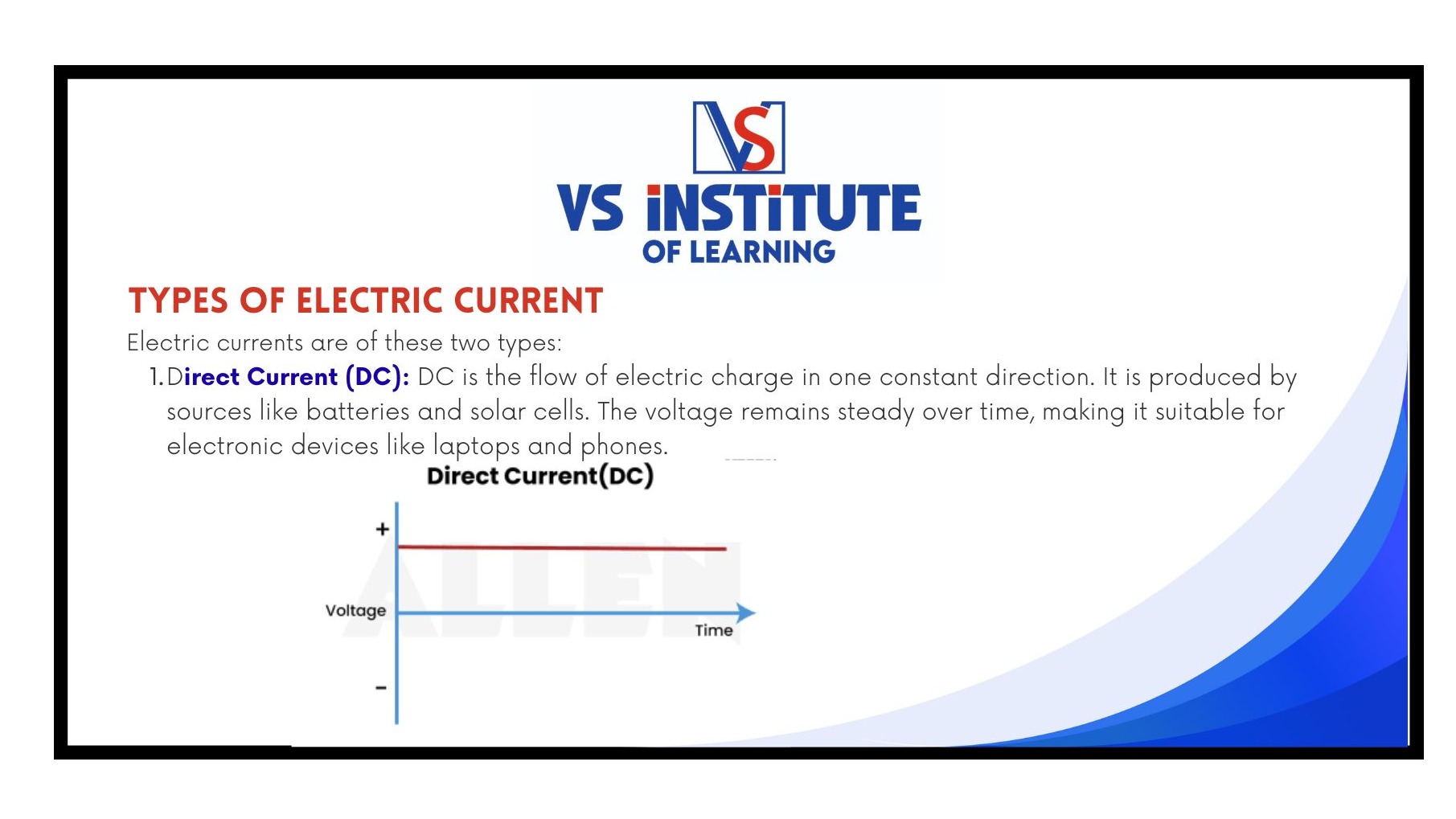
Direct Current (DC) is an electric current that flows in one constant direction. Unlike alternating current (AC), which changes direction periodically, the electrons in DC move steadily from the negative terminal to the positive terminal of a power source.
Symbolically:
Current I flows from positive (+) to negative (−) in conventional current notation.
In terms of electrons (which are negative), they flow from negative (−) to positive (+).
Characteristics of DC
1. Unidirectional Flow – The current always flows in one direction.
2.Constant Magnitude – Ideally, the voltage remains constant over time.
3.Representation – On a graph of voltage vs. time, DC is shown as a straight horizontal line.
4.Energy Transfer – Delivers continuous energy, suitable for devices requiring steady voltage.
Applications of DC:
1.DC is widely used in areas where constant voltage is required:
2.Electronics – Computers, smartphones, and TVs all use DC internally.
3.Battery-Powered Devices – Flashlights, laptops, electric vehicles.
4.Electroplating & Electrolysis – Requires steady current for chemical reactions.
5.DC Motors – Used in robotics, small appliances, and electric trains.
6.Telecommunications – Telephone lines and some communication devices rely on DC.
Advantages of DC:
1.Provides stable voltage, suitable for sensitive electronics.
2.Easier to store in batteries and capacitors.
3.Useful in electrochemical processes.
4.Simpler to control in small motors and circuits.
Disadvantages of DC:
1.Difficult to transmit over long distances compared to AC (because of power loss).
2.Conversion to higher or lower voltages requires DC-DC converters.
3.Not suitable for standard household power grids, which mostly use AC.
DC is the unidirectional, constant flow of electric charge, essential for electronics and devices requiring stable voltage.